
A missing bestseller can cost more than one lost sale. It can send a regular customer to another store, disrupt a food-service menu, or leave a buyer scrambling to explain an avoidable gap. FMCG wholesale is therefore not simply a purchasing function. It is a sales-continuity decision that affects availability, margin, customer confidence, and the pace at which a business can grow.
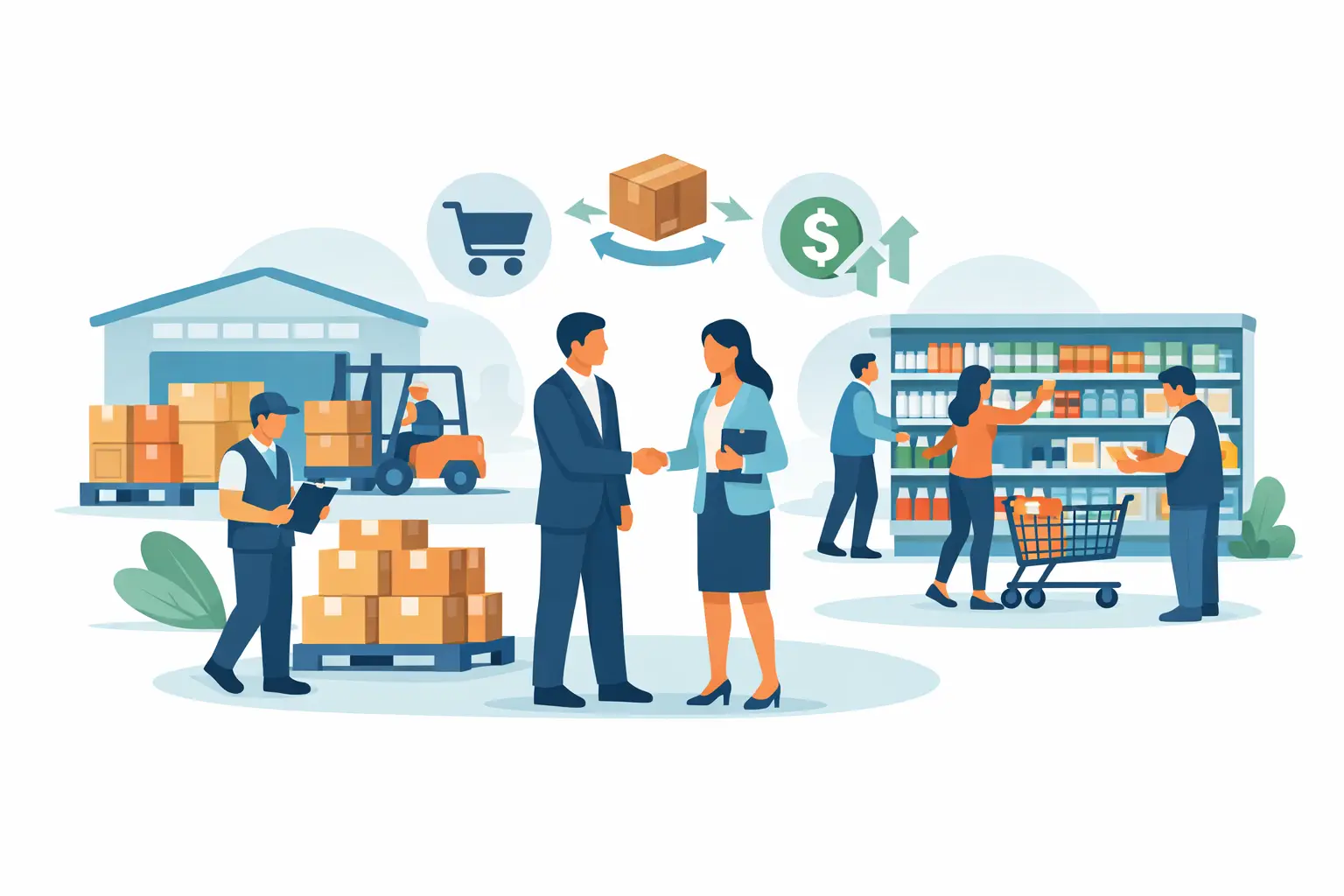
For retailers, convenience operators, distributors, and food-service buyers, the strongest wholesale partner does more than confirm an order. It protects the flow of recognized brands from sourcing through storage, market-ready preparation, and delivery. That full chain matters because fast-moving consumer goods move fast only when every operational step performs.
FMCG Wholesale Is About More Than Product Access
Branded beverages, confectionery, snacks, grocery products, and other everyday goods earn their place on shelves because customers recognize them and buy them repeatedly. Access to those products is essential, but access alone is not enough. A supplier may offer an attractive price on paper while creating commercial risk through inconsistent replenishment, limited warehouse capacity, unclear lead times, or poor handling of product requirements for a specific market.
A capable wholesale operation connects commercial terms with operational discipline. It understands which products drive daily turnover, which seasonal lines need to arrive before demand peaks, and which pack formats work for a particular retail channel. It also recognizes that a pallet sitting in the wrong location, or a product arriving with unsuitable labeling, is not an available product in practical terms.
The result buyers need is straightforward: the right branded merchandise, in the right quantity, ready for sale, delivered when promised. Achieving that result requires specialized sales knowledge, active inventory control, flexible logistics, and the ability to adapt products without compromising quality.
What a High-Performing Wholesale Partner Delivers
Consistent Availability of Recognized Brands
Core FMCG lines should not be treated as occasional buying opportunities. They should be managed as the backbone of a dependable assortment. High-turnover products need stock planning that accounts for historical sales, promotional demand, seasonal patterns, lead times, and the realities of transport capacity.
This is particularly important for independent retailers and convenience stores, where a limited shelf footprint makes every SKU work harder. A well-chosen assortment of trusted brands can drive repeat purchases and support stronger basket value. For chain procurement teams, the challenge is different but equally demanding: supply must remain consistent across locations and over longer planning cycles.
The best commercial terms lose value if the supplier cannot maintain availability. Buyers should look for a partner with the sourcing reach and warehouse capacity to support regular replenishment, not just one-off deals.
Product Preparation for the Market
International trade creates opportunity, but it also creates practical requirements that can slow a product launch. Labels may need translation. Packaging may need adaptation for a customer, retail format, or destination market. Case configurations can need adjustment to improve handling, shelf replenishment, or promotional execution.
These services should sit close to the distribution process, not become a separate problem for the buyer to coordinate. When labeling, repackaging, and quality control are managed alongside inventory and delivery, products can move to market faster and with fewer handoffs.
There is a trade-off. Product adaptation requires planning time and clear specifications, especially for large or recurring programs. However, this investment is often far less costly than receiving merchandise that cannot be placed on shelf or sold through the intended channel. A partner that handles these details accurately helps buyers reduce compliance risk and protect launch timing.
Warehousing That Supports Sales, Not Just Storage
Warehouse space is valuable when it creates flexibility. Buyers may need to place larger orders to secure favorable terms, build stock ahead of a promotional period, or consolidate deliveries across several product categories. Without reliable storage and stock visibility, those opportunities can become burdensome.
Professional warehouse operations turn inventory into a managed commercial asset. Goods are received, checked, stored under appropriate conditions, picked accurately, and prepared for dispatch according to the buyer’s delivery requirements. This supports faster order fulfillment while reducing the risk of damaged, misplaced, or aging stock.
For food-service operators, dependable warehouse management can be the difference between a fully supplied operation and a disrupted service day. For distributors, it provides the foundation for predictable onward delivery. In both cases, precision matters as much as capacity.
Delivery Discipline Across Channels
On-time delivery is not an added benefit. It is a basic condition of effective FMCG distribution. Retail teams plan shelf replenishment around delivery windows. Food-service businesses plan purchasing around consumption cycles. Trade partners need reliable departures and documentation to keep their own supply networks moving.
A strong delivery operation combines route planning, loading accuracy, shipment coordination, and proactive communication. It should also be flexible enough to accommodate the different realities of retail, wholesale, and export channels. A full-truck delivery to a distribution center is not managed the same way as a mixed order for a convenience-store network.
Reliability also means addressing exceptions quickly. Shortages, changes in demand, and transport delays can occur. The critical question is whether the supplier identifies the issue early, communicates clearly, and provides a workable alternative. Buyers do not need vague assurances. They need practical answers that protect sales continuity.
Building an Assortment That Earns Its Space
A broad catalog is useful only when it is commercially relevant. Buyers should evaluate assortment through the lens of turnover, margin, shopper demand, and channel fit. The goal is not to add products simply to appear comprehensive. It is to build a portfolio that gives customers familiar choices while creating room for incremental sales.
Start with proven branded products that deliver dependable velocity. Then add complementary lines that increase choice without diluting the category. A convenience store may prioritize immediate-consumption packs and high-frequency favorites, while a food-service customer may need larger formats, menu-compatible products, or products suited to back-of-house storage. An international buyer may place greater emphasis on packaging, labeling, and market-specific presentation.
Merchandising support adds value at this stage. Product placement, visibility, and shelf logic influence whether an item is noticed and purchased. Even strong brands can underperform when they are poorly positioned, out of stock, or displayed without a clear category role. A distribution partner with retail execution experience can help translate assortment decisions into better on-shelf performance.
How to Assess an FMCG Wholesale Partner
A supplier conversation should go beyond product lists and headline prices. Commercial buyers need to understand how the operation performs when volume increases, demand changes, or products require special handling. Four questions reveal a great deal:
- Can the supplier maintain stock of core brands and communicate availability clearly?
- Does it offer storage, labeling, repackaging, and delivery as coordinated services?
- Can it support the buyer’s specific channel, from retail shelves to food service or international trade?
- Is there an accountable team that can respond quickly when an order needs attention?
Pricing remains essential, but it should be assessed alongside total operating value. A slightly lower unit price can be outweighed by missed delivery windows, fragmented shipments, relabeling delays, or the internal time required to manage multiple suppliers. The right partner reduces those hidden costs and gives purchasing teams more control over their category plans.
At Nápoje SP, this end-to-end approach brings sourcing, storage, product adaptation, specialized sales, merchandising, and delivery into one focused distribution model. For customers, that means fewer operational gaps between purchase order and shelf availability.
Choose the Partner That Protects Momentum
FMCG demand rarely waits for a supplier to catch up. When shelves are full, products are correctly prepared, and deliveries arrive as planned, buyers can focus on promotions, expansion, customer experience, and profitable growth. When supply is uncertain, every day becomes a recovery exercise.
The right wholesale relationship should make growth easier to manage. Choose a partner that treats every order as part of a larger commercial promise: keeping the brands your customers expect available, visible, and ready to sell.